


Luca Zamoc
- Aug 2, 2016
- 2 min read
La porta della città.
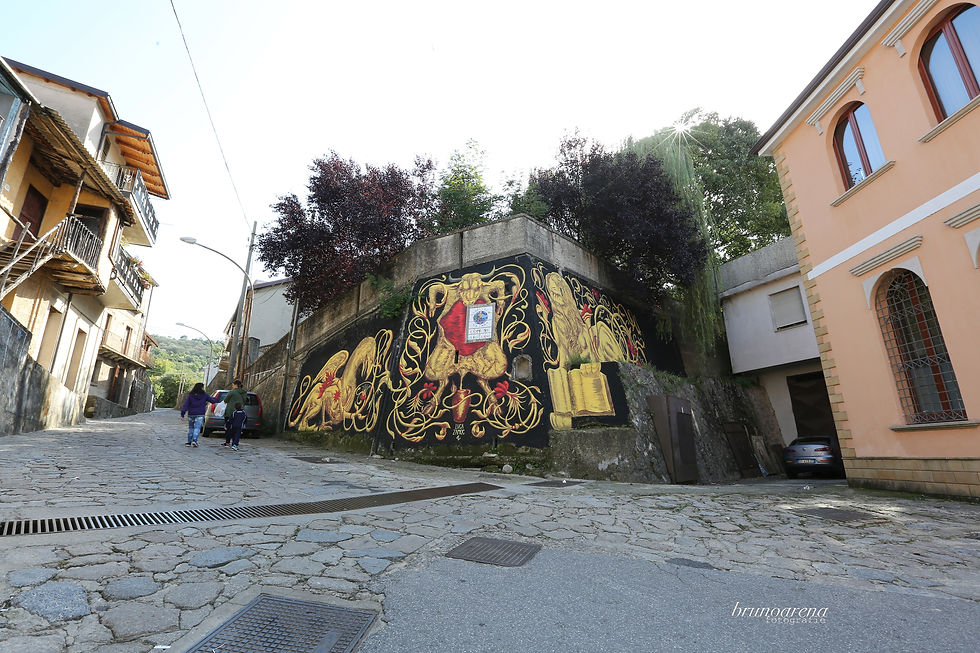
Una delle strade che conducono in piazza, al cuore del paese, passa davanti il muro di contenimento della scuola, al lato del Municipio, sulla cui parete fino a luglio si trovava solo una targa del Giubileo e una piccola edicola votiva. Qui Luca Zamoc ha regalato magnificenza alla parete con una decorazione bicolore, gialla e rossa su sfondo nero dando il 'benvenuto' a chi arriva in paese.
Ricordando le rappresentazioni degli antichi portali che accoglievano i forestieri e avevano il compito di proteggere le città e i propri cittadini, ai due lati della parete sono rappresentati una sfinge e un grifone. Tra di loro, un toro che si erge sopra un vaso in terracotta, espliciti riferimenti alle attività artigianali che hanno caratterizzato la produzione del paese: la concia delle pelli e le produzioni in terracotta. Nonostante il forte impatto cromatico e compositivo, la parete nasconde importanti simbologie.
La sfinge con ai piedi un libro aperto che ricorda il celebre leone di Venezia, in realtà sta a simboleggiare Marco, uno dei quattro evangelisti. Il simbolo di San Marco, infatti, è il leone poiché nel suo Vangelo narrò il maggior numero di profezie che Cristo fece riguardo la propria risurrezione e il leone, in virtù della sua fortezza, rappresenterebbe proprio la risurrezione e quindi la rinascita.
Essendo interamente visibile mentre si giunge in paese la parete pare voglia dare ilbenvenuto, auspicando che quella strada venga nuovamente percorsa in entrata sia da artigiani che dai gerocarnesi per favorire la rinascita artigiana e sociale del paese.
The gateway of the town
One of the main roads which leads to the main square of the town runs in front of a school. On the wall close to the Town Hall there were only a plaque for the Jubilee and a votive stand.
On that wall, the artist Luca Zamoc placed an external decoration two-colored, yellow and red over the black background in order to welcome those people reaching the town. Recalling the decoration on the ancient portals, he painted a griffin and a sphinx aside the wall. Between those two animal, a bull is painted standing on the top of a terracotta vase. The figures refers to the local crafts which characterized mostly the town: the tanning and the production of terracotta. Although the heavy impact led by colors, the wall hides important symbols.
The sphinx which holds an open book among its feet, recalls the more famous lion in Venice. In fact, it symbolizes Marco, one of the four evangelists. The symbol of Saint Marco is the lion since in his Gospel he wrote the higher number of prophecies concerning his own resurrection and the lion. Due to its strength, the lion stands for the resurrection and rebirth.
Being visible to anyone arriving at the town the wall looks a welcoming billboard. We wish that new artisans and local inhabitants will walk again through the same road in order to fuel the social and economical resurgence of the town.
Comments